


News

Do Cat Spikes Work? Types of Cat Deterrent & Repellents
Cats are naturally curious and when allowed to roam freely outdoors most domestic cats explore as far as about a quarter-mile away from their home, although there are reports of some cats traveling as far as two miles! Generally preferring to explore their own neighborhoods, cats climb trees and hunt in wooded areas nearby, hang out with other neighborhood cats, and most certainly explore their neighbors’ yards and gardens - even though some neighbors may not care for cats wandering in their yards. There are several cat containment solutions available from cat fencing to cat rollers, and even catios. However, these solutions typically work to keep cats safely contained inside a designated space rather than deter them from entering a specific area. Cat Repellent Spikes One common solution that people turn to for keeping cats out of their garden or other areas of their yard is cat spikes. Some people may line the tops of their fences with cat spikes in an attempt to prevent cats from climbing into their yard entirely. Others may place cat spikes on the ground to prevent digging or in more specific areas where they don’t want roaming paws to enter, such as underneath bird feeders, inside flower beds, or around vegetables. Some cat owners may even place them indoors in areas like countertops and furniture to show their cats that these areas should be avoided. Cat spikes are designed to create a physical barrier that is unpleasant for cats to step foot on. In theory, this should prevent them from walking over the spikes into areas where they shouldn’t be. While the term “cat spikes” may conjure up images of sharp metal points that could harm cats or other animals, they are actually most often made of plastic or rubber. There are two main types of cat spikes: “Cone” spikes: This option features a strip of material with a series of plastic or rubber cone-shaped spikes attached. The spikes have a blunt tip design so they don’t harm the cat, but do make the surface uncomfortable and difficult to walk on. Each strip of spikes can be secured to a variety of surfaces from concrete to metal and wood, and easily cut to specific lengths making their applications quite versatile. “Scat mats”: These are similar to cone spikes in utility but have a slightly different design. Scat mats are larger and made with a series of small plastic spines (think: the underside of a plastic desk chair mat, enlarged). A scat mat is capable of covering a much larger space both outdoors and indoors. For example, a scat mat can be placed in a garden where a neighborhood cat prefers to use the bathroom. The mat covers the ground so the cat is not able to dig or do their business comfortably. Scat mats can also be lined up on a countertop or table to prevent a cat from jumping up and making themselves comfortable. The plastic spines feel strange under the cat’s feet and should prevent them from exploring these areas deemed “forbidden.” Cat Spikes Reliability and Effectiveness Based on our analysis of thousands of product reviews from various retailers, the consensus is that most cat spike products are effective on approximately 50-60% of cats. The most commonly cited issue is that the spikes don’t bother or deter cats. As you may surely know, all cats are different and have unique personalities. For just about every cat that cannot stand the feeling of the spikes under their feet and will avoid the cat-proofed area altogether, there is another cat who is completely unbothered by walking on cat spikes or scat mats - or perhaps they are just too stubborn to be discouraged! For these cats, the rate of effectiveness drops to essentially zero. Interestingly, many of those cats who avoid the cat spikes initially, will slowly get used to the spikes and become less bothered by them. This ultimately reduces the effectiveness significantly over time for the majority of cats. Are Cat Spikes and Bird Spikes Legal? The laws, rules, and regulations regarding the use of cat spikes vary from one location to another, so it’s always best practice to check with your local regulatory authorities before installing these types of deterrents. Unsuitable Alternatives When considering the other options for keeping cats off fencing, and out of flower gardens and other areas, a third option is other various versions of spikes designed for other animals such as fox spikes, squirrel spikes, chicken spikes, and bird spikes. Bird spikes in particular are commonly used with cats. These are typically made of thin skewer-like metal rods meant to deter birds, such as pigeons and crows, from landing on a fence or building ledge. This type of spike does tend to be sharp, as it is meant to replicate thornbush and is intended for use with birds only. The skewer-like rods can cause injury to soft kitty paws. Because of the potential injuries cats could experience, they should never be used as a deterrent for cats or other animals like raccoons and squirrels. Only cat spikes made of plastic or rubber, with blunted tips should be used as a cat repellent option. More Effective Alternatives When it comes to deterring cats from entering your gardens or yard, there are several other, more effective options. A good place to start is simply communicating with your neighbors. Many cat owners are likely not aware of the troubles their cats might be causing for you, so calmly approaching them with your concerns might lead to a productive conversation and some resolution. Another option you have is to be conscious of your landscaping and gardening choices. There are many plant options that can help repel cats and deter them from entering your flower and vegetable gardens. A cat’s sense of smell is 14 times better than most humans. Because of this, they are far more sensitive to scents, and might even be able to smell things that we can’t! So planting flowers or other plants that have a displeasing scent to cats can actually help prevent them from entering your garden. These plants include: Coleus Canina - Also known as the "Scaredy Cat Plant", it is said that this plant actually smells like urine, which causes cats to avoid the area where it is planted. Geraniums - They have a scent that cats tend not to like, but most humans do! Citronella - A plant in the geranium family, this one has a citrus smell that cats do not enjoy. Lavender - Another plant that smells great to most humans, although cats avoid it. Even some fragrant herbs like lemongrass and rosemary have an unpleasant smell to cats! Other planting options that can help deter cats would include anything thorny or prickly - roses, holly, barberry, cactus, bougainvillea, and blackberries, for example. These types of plants work best when planted along the perimeter of your garden to prevent cats, and other animals, from entering the garden. One of the most effective options is to install cat containment systems such as cat fencing. There are a variety of cat containment options available from full-height fence barriers, to cat-proof fence toppers and even cat rollers (sometimes called coyote rollers). Admittedly, most of these fencing options are designed to keep cats contained within a yard or specific area. However, many of them can also be used “in reverse” to humanely and effectively prevent cats from entering an area. TLDR; There are a variety of cat spike options available to deter cats from entering a specific area. Spikes should be made of plastic or rubber and have a blunted point when used to deter cats from entering a specific area - never use spikes made of metal or spikes that are sharp and could cause injury to cats or other animals. When installed properly, cat spikes are effective approximately 50-60% of the time based on various product reviews. While some cats avoid stepping on cat spikes at all costs, many others are unbothered. The majority of cats will likely become used to the spikes with prolonged exposure, reducing their overall effectiveness over time. More effective deterrent options include communicating with neighbors, cat repellent landscaping, and physical barrier containment solutions like cat fencing. To learn more about the many ways Purrfect Fence can help you exclude or contain cats safely outdoors, please visit PurrfectFence.com.
Learn more
Does Aluminum Foil Work to Keep Cats Off the Counter and other Surfaces?
In a recent internet trend, cat owners shared videos of their cats’ panicked reactions to aluminum foil. Video after video shows cats startled by foil-lined tables and countertops, comically leaping away as soon as their paws touch the foil. But does aluminum foil really work to keep cats off tables and countertops? What are they so frightened by? Aluminum Foil is Weird to Cats First and foremost, aluminum foil is just plain weird to cats. Especially if they are used to leaping up onto the countertop without ever having seen it there before. It would be like if one day on your normal commute to work, you found that the road was suddenly covered in decorative rugs. You might find it a little odd, and would likely be a little apprehensive about driving over them. Maybe you would even consider taking an alternate route to avoid them. This combined with the fact that there is nothing like foil in the wild makes aluminum foil very peculiar to cats. They have no frame of reference on what exactly it is or how to deal with it. Cats Hate the Look, Feel and Sound of “Tin” Foil Aluminum foil also has some unique properties that make it particularly alarming to cats upon their first encounter. When moved, bent, or stepped on, the foil has a very distinct high-pitched crinkling sound. Crinkling aluminum foil actually emits a sound so high-pitched that it reaches into the ultrasonic range. Our human ears are not adapted to pick up on ultrasonic sounds, so for us, this sound may not be so bothersome. But cats are far more sensitive to high-pitched sounds. Many of their natural prey like mice and rodents communicate using ultrasonic sound, so it’s no wonder cat ears are fine-tuned to pick up on such high-pitched noises! While we may not be able to understand exactly how the crinkling foil sounds to a cat, it’s possible that it’s similar to nails on a chalkboard for humans.The sudden, high-pitched crinkle in combination with the unusually smooth texture of foil when the cat is not expecting it can potentially cause a sensory overload. According to an article published by the International Association of Animal Behavior Consultants, “Cats have an innate fight or flight response to fearful situations and would prefer to flee and hide from a perceived threat.” It is certainly possible that a sensory overload could create a fearful situation for the cat, which triggers their instinctual flight response - when in doubt, flee from the potential threat!Another theory is that the foil replicates some of the same traits as water - it’s shiny and reflective like water. If a cat had not been exposed to foil before, and suddenly there was a large “puddle” of it on the floor or countertop, it’s possible that it could be mistaken for water at first glance. In general, it’s safe to say that cats prefer to stay dry. So if the foil is initially perceived to be water, then most cats would likely be hesitant to walk right onto it. It is difficult to say for certain if cats really are tricked into believing the foil is a body of water, but if it is something that they have never encountered before then it is likely that it simply presents a risk they want to avoid. Cats Will Eventually Become Comfortable With all of the weird and unnatural features of aluminum foil aside, repeated exposure to foil diminishes the frightening aspects of it to most cats over time. After the cat has realized that the foil actually does not pose any type of threat (and is not liquid!), they become significantly less bothered by it. Instead of jumping away from the foil-lined surface, they will eventually confidently walk right over it. And, of course, there are also many cats who have absolutely no reaction to aluminum foil whatsoever, or decide to play with it instead! Sure, there are some cats that may never get used to the aluminum foil crinkle, and for those cats keeping the countertops and tables lined with foil will probably prevent them from leaping on top. However, for the wide majority of cats, this is not a long-term solution. Aluminum foil presents a potential threat and has the “scare factor” initially, but most cats will quickly realize that it’s nothing more than a shiny, fabulous surface to walk on (and maybe it sometimes makes some strange noises.) Finding a Better Solution If you're tired of your cat jumping on the counters and the aluminum isn't working we recommend giving your cat some safe outdoor time. It's been proven that a cat's behavior and mental health improves when they spend some time outdoors each day. To help keep your cat contained and safe in your yard there are many fencing options from extension kits to DIY freestanding fences. Contact us for your Purrfect Fence recommendations.
Learn more
Cat Fence Rollers - What You Need to Know
Being a pet parent is tough! There are so many options out there for everything pet related that the decisions we have to make on behalf of our pets can sometimes feel endless. But the one thing pet owners can all agree on is that safety for their pets is important, and so is access to the outdoors for nearly all animals, including cats. Many cat parents commonly search for ways to cat-proof their yard so their feline family members can spend time safely outdoors - Because why should dogs get to have all the fun!? The good news is that there are several outdoor containment options available specifically for cats. There are a lot of factors to consider when determining which type of cat-proof solution will work best for your cat, and most cat fence containment systems will fail to work reliably on all cats. The important thing to keep in mind when deciding which option will work best for you is not necessarily, “Does the system work for all cats?” but rather, “Does it work for MY cat?” One option that is commonly considered as a cat-proof fence solution is a roller system. How Do Cat Fence Rollers Work? Fence roller systems were initially designed and used to prevent large predator animals like coyotes and dingos from climbing over a fence, which is why you may often see DIY cat fence rollers also called “coyote rollers.” Coyotes are anatomically similar to dogs, so the way in which they scale fencing is quite similar. They tend to jump up and use their forward momentum to advance up the fence. When they reach the top, they can use their front paws to grab the fence and their back paws to push themselves over. With rollers installed at the top of the fence, the coyote cannot grab a hold of the fence, and therefore, cannot climb over. Cats, on the other hand, have very different abilities, as they are able to stop their forward momentum and hold on to many surfaces with their claws before continuing their climb. This allows them to pause and search for the “path of least resistance” as they approach the top of the fence, calculating their next move. Many cat-proof fence roller systems have been adapted from the original coyote rollers with this in mind, and now there are several options available exclusively for use with cats. Cat proof fence rollers, like coyote rollers, feature a long piece of tubing with an inner support that causes the tube to spin when the cat tries to grab a hold of it. Some rollers use smooth outer tubing that is difficult to grip, others have “paddles” that make it difficult for the cat to get a foot-hold. They are installed along the top of a fence, so if your curious cat makes its way up to the top and they try to grab onto the roller, it spins so that they cannot hold onto the top of the fence to climb out. With nothing to grab onto to steady themselves and nowhere to go, they are forced to drop back to the ground below. Cat Fence Roller Pricing When compared to other types of outdoor cat containment systems, cat-proof fence rollers tend to be more expensive, especially for options made with high quality materials. For example, if you have 100 linear feet of existing fence, you can expect to spend approximately $1,000 on a commercially available roller system. Less of course if you choose a DIY solution, but there are often issues with durability and even more issues with effectiveness. However, if you have a smaller space like a fenced patio or porch, it can be a more non-intrusive and budget-friendly option. What Options Do You Have? Because rollers have been around for at least 20 years for use with wild animals like coyotes, there are several DIY plans and tutorials that use materials that can be found at most hardware stores. Building your own DIY cat fence rollers may be a more cost-effective option, however, it also relies on the use of materials that were not necessarily intended for this type of application. While some have success with a DIY roller system, the use of these types of materials may result in unexpected results and ultimately reduce the effectiveness or durability of homemade rollers. Image Credit: City of Ipswich Effectiveness of Fence Rollers with Cats When installed properly on most fence types, reports suggest that commercially available cat-proof fence roller systems tend to have a 80-90% rate of effectiveness for most cats. Cats all have unique personalities and abilities, and while some cats may try to climb over the fence and give up after a few attempts, others might try over and over again until they find a way over and out. Rollers tend to be best suited for cats who are less athletic or persistent. Additional modifications can be made to your existing fence to increase effectiveness for more persistent cats, such as installing spans of polycarbonate material along the top of the fence in addition to the rollers or increasing the overall height of your existing fence. Polycarbonate is a type of clear plastic sheeting that cats are not able to get their claws into, making it even more difficult to scale the fence. And as with any cat-proof containment system, things like trees, outdoor furniture, and garbage bins should always be moved away from the fence. These types of items are often used as escape aids by persistent cats who are determined to get out of the yard. Moving them a safe distance away from the fence can greatly increase the effectiveness of most cat-proof fence solutions, including rollers. It is also important to keep in mind that the areas most commonly exploited for escape over roller systems are gates, corners, and where existing fencing meets a structure. These areas may require special care when preparing and outfitting your fence with rollers. Installation Most cat-proof fence rollers have a relatively easy installation process that allows you to get the entire system installed quickly as long as no sections need to be cut to length. For most commercial systems, it’s as simple as securing brackets to your fence and inserting the rollers as you go. Tubing lengths can be cut as needed, but may require additional tools that are not commonly found in garages and home tool boxes. Once installed, rollers made with high quality materials will require very little maintenance to keep them in working condition. Proponents of cat fence roller systems champion the aesthetic appeal and minimal intrusiveness in comparison to other containment options. They can be installed along the top of your fence without significantly compromising the look of the fence. Some commercially available rollers can even be purchased in a variety of colors to better blend in with your existing fence. Cat Fence Roller Drawbacks Although cat proof fence rollers have these advantages, it is important to take a look at the potential drawbacks as well. For example, they can only be installed in yards that have an existing fence and are not recommended for fences less than 6 feet tall. Cats have impressive leaping abilities. In fact, research suggests that the average domestic cat can leap vertically up to about 5 feet! This means that when fence height falls below 6 feet, there is an increased chance of escape for cats to simply jump over the fence - even with a cat-proof roller system installed! Installation heights of at least 6 feet generally force cats to climb in order to attempt escape. Unfortunately, there are no ready-made roller solutions for other common fence heights that fall below 6 feet. Additionally, cat fence rollers are not always appropriate for all fence types and configurations. There are many areas where a seamless perimeter cannot be achieved. Most commonly, these areas are around gates, corners, and where existing fencing meets a structure. In these particular areas, brackets are required to accommodate splits, turns, and endpoints, respectively. This can leave gaps between the rollers which are left vulnerable to escapes. Particularly for Houdini cats! These intelligent and persistent cats locate and exploit these gaps in order to climb over the fence and out of the yard. In some instances, they may even find that when they reach the top of the fence, they can reach right over the roller and jump out. It is because of drawbacks like these that Purrfect Fence has not elected to develop a roller system. Our extensive multi-decade long testing and research shows that a physical barrier solution paired with the collapsible arm extension proves to be far more effective and infinitely more flexible in its application. What the unique cat fence topper lacks in aesthetics, it more than makes up for in ease of installation and the safety of your beloved pets. Consider exploring our approach more to keep your cat safe, happy, and healthy outdoors! Learn More About Purrfect Fence Cat Fencing Options
Learn more
All About Cat Runs: Options, Considerations, & Best Practices
Cat runs are an increasingly popular option for those who want to enrich their pet’s life by giving them access to the sights, sounds, textures, and smells of outdoor spaces. Cats, like humans, dogs, and many other animals, enjoy the stimulation of the outside world. Also referred to as a catio, cat enclosure, or cat kennel, there are even more options than names for them! Since your internet search has likely brought you here, you are probably in the middle of your research to find the best catio cat run for you. Here are several options to help you decide which is perfect for your beloved pet. Outside Cat Run Options 1. Design and Build a Custom Cat Run A commonly selected option for those with skills, confidence, or both is to take on the challenge of designing and building your own cat run. This generally involves using raw materials purchased at home improvement stores. Then, the individual makes either a design discovered online or attempts to replicate a more formally engineered solution from the commercial options available. These options generally are one of the following: Fully enclosed enclosure made from wood framing with welded wire covering. Example plan here. Modified existing fencing with PVC rollers, arching arms, or a variation of each. Example here. These outside cat runs can be wonderfully successful for people with the right skills and budget. The issue is that the majority of people who attempt this do not see great results due to the difficulty of building durable solutions for the outdoors. Also, and maybe more importantly, cats tend to be extremely athletic, clever, and persistent, and will exploit even the slightest mistake you make. Unfortunately, mistakes can often lead to escapes. Expected Cost: $500-5000 Expected Time Commitment: 16-40 hours 2. Hire a Contractor to Design and Build Your Catio Cat Run A popular option for those with a higher than average budget is to hire a local contractor to design and build your cat run to suit. Contracting out your run is a great option if you can find a competent and experienced outside cat run builder. Custom options often are in the higher pricing range due to the cost of design, materials, and labor involved in the process. Professionals that offer these services are usually in high demand. Custom cat runs built by contractors are typically wood-made and often require significant maintenance due to the material quality. Expected Cost: $1500-10000+ Expected Time Commitment: 1-6 hours 3. Commercial Do It Yourself Cat Run This option removes a lot of the guesswork and confusion around your outside cat run's design and material selection. Many different companies offer various solutions. Some are based on the idea of open-air fencing barriers, such as Purrfect Fence, while others rely on fully enclosed catio-style enclosures like those offered by Habitat Haven. Be sure to check out the tunnels and towers. The homeowner can install these options, or a local handyperson can be hired for assembly. DIY solutions tend to be the most economical overall, considering the level of durability and effectiveness of these systems. Expected Cost: $500-5000 Expected Time Commitment: 2-6 hours Build Your Outside Cat Run with Purrfect Fence No matter which cat run option works for you, it is important to ensure you are fully comfortable with its level of safety, effectiveness, and cost. You should also find out what it will take to fit the catio cat run to your situation properly. It certainly helps to carefully review the various options and talk to as many experts on the subject as possible. Ready to work with the world-renowned experts at Purrfect Fence to see if our outside catio cat runs are suitable for you? We would be happy to consult with you via email or phone. We think you will be pleasantly surprised by how helpful we can be! Contact us here.
Learn more
The Most-Common Mistakes Installing the Existing Fence Conversion System (and how to avoid them)
Most traditional fences were not laid out with cat containment in mind. There are many things that can make an existing fence challenging to make cat-proof. The best advice we can give our customers of the Existing Fence Conversion System is to plan out how to apply our system to your fence prior to beginning the installation. In reviewing the instructions and this planning guide does not answer any specific questions, please contact us and include whatever diagrams or photos we will need to help you. This article is addressing general scenarios common to many fence types. We attempt to address some of the more common issues below. But, cat proofing an existing fence is dynamic and very much an art more than a science. If you encounter issues not covered in the instructions or below you are welcome to contact us so we can assist you. Fence Ends At the Corner of a House or Building The single most common mistake we see here at Purrfect Fence is a poor beginning/ending of the system at a building. This can take many forms but the biggest offender happens when the existing fence line runs into the back corner of the house parallel to the back of the house. The mistake made is that only one arm is mounted to the post against the back corner of the house. This makes it so the end of the fence is just at an arm that is not against anything. The cat could climb the post and just go around the arm. If your fence end like this against the corner of a building, you need an extra arm to finish the fence. Fence Ends Just Barely Offset to the Corner of a Building or House A variation on the first scenario is when the fence comes into the side of a building but not far enough towards the front side of the house to allow the majority of the arm to finish against the side of the house. If that distance is a few inches to about a foot, you would need to add an arm mounting bracket and arm to the side of the house: If the distance is 22”+ you may want to just have the arm against the side of the house and the tip of the arm sticking past the back corner just a bit and observe your cat(s) to see if any attempts at escape happen at that endpoint. The very tricky scenario is if that distance is 12” to about 21”., Here is one way to handle that situation: This method uses (3) arms in one mounting bracket secured to the back of the house at the corner. Existing Fence Changes Height or Steps Down Another recurring customer mistake is what to do about a fence that changes height. It is not necessary to position the arms to imitate the “steps”. This would require two arms and mounting brackets on each post and the end result would make a pretty big weak point at every post. The way to handle a stepped fence is to set the arms at a constant slope: Trees and/or Shrubs Near the Fence Line Things growing near the fence can block installation of the arms and fence, interfere with the function of the system and/or allow a cat to get on top of the system by climbing. Sometimes a tree/shrub problem can be solved with a bit of trimming. Sometimes things can be added to the tree to keep a cat from being able to climb it. Sometimes a choice needs to be made between cutting down that tree or shrub or running Free-Standing fence in front of it excluding the offending plant. The mistake made here is not thinking that a tree or shrub is going to cause a problem so our system gets run right past it like it is not even there. An even bigger mistake is thinking that “the cat is not going to climb/ go through this" and so the section is left open altogether. Trees near the fence with no low branches near the fence can often be handled be securing something hard and smooth to the tree that the cat cannot dig their claws into such as our proven DIY solution for cat proofing trees. For a large tree against the fence, arms directly on the tree can be the best answer: For trees that are within a few feet of the fence line, it can often be best to outfit them with a "baffle." Trees with low branches or tall shrubs can take a different solution. A very common type of planting is tall evergreens like arborvitaes right against a fence. Your choice for this scenario is either cut the trees down or to about 3ft high or “box them out” by running our Free-Standing system in front of them: Here is a situation where tall evergreens are growing against a fence into a corner of wood fence. One way to handle it would be to “box out” the evergreens with Free-Standing fence. A gate would be needed to access the area: Another way to secure the section with evergreens would be to more closely follow the fence line like: Although you could put the Free-Standing fenced right against the evergreens and skip the gate, you would leave no room for maintenance and the trees would likely grow into the fence. The problem with this is that these types of trees typically have flexible trunks and strong winds and snow loads could then damage the fence with the movement of the trees. Take the evergreens and replace them with vines on the fence or some other growth. This is still handled in a similar manner. Cats will climb what you think they will not climb if they want to get out and you cut off every other way with our system. Even if the vines or whatever the growth is “impenetrable/unclimbable” (and it isn’t) there is no good way to end our fence and then restart it against plants making those the weak points. How to make the mesh fencing material look aesthetically pleasing The key to hanging the fence from the arms so the finished fence looks as good as possible is primarily the positioning of the arms. This is especially true on relatively flat/level areas. Set the first and last arm mounting bracket in a straight line of fence on level ground (so end to corner/corner to corner section). Use a string pulled tight from the first mounting bracket to the last mounting bracket to determine exactly where on the post to mount the other mounting brackets. Try to mount the arms so they are all at the same height in the arm mounting rings on the plates. Check your work by looking down the line of installed arms and seeing if any are higher or lower. If so, adjust those arms and recheck. After that is done for the entire fence, begin the installation of the poly fence as prescribed in the instructions. If there are any sags, they can be adjusted out but only after all the poly fence is installed. Removing Sagging or Tweaks in Mesh Fencing Material The fence behaves like a sheet and has very little stretch. For this reason, trying to “pull out” sags between arms does not work out well. The way to minimize/eliminate sagging between arms is to make long narrow triangle-shaped folds in the fence similar to pleats and darts in fabric. This is done by securing 1 or more squares of fence together with zip ties or hog rings. This is done in line top-to-bottom or bottom-to-top. This is also done at arms to minimize the visual impact. If the sagging is more towards the tip of the arm, then the folding will be greater at the tip and will decrease as you work your way towards the bottom of the arm. An example would be three squares of fence cinched together at the top edge and then two squares closer to the spring joint, then one square after the spring joint and then none were the arm meets the mounting bracket. You will need to secure in-between the noted cinches every other square as you work your way down. If the sag in the fence is greatest on the lower part of the arm, the cinching will start at the bottom edge of the fence and work its way up.
Learn more
More to Cat-Proofing than a Purrfect Fence!
Picture a flat expanse of a featureless grass field. The simplest of yards requires only a (Purrfect Fence) cat-proof fence to form a flawless cat containment enclosure. Other than being sure to install the fence correctly, no other efforts or considerations are needed. Install that same fence in a similar field but with a tree and the dynamic changes. Cats can climb trees. If the cat climbs the tree, can they drop onto the top of the cat-proof fence? Can they walk out a branch and jump to the top of the cat-proof fence? Things Big & Small, Your Cat can use Them All ..to Escape! The typical back yard has more in it than grass and one tree. Think of all the things in your backyard.. trees, shrubs, tables, chairs, grills, etc. Now think of the part of the house that would be included in the fenced area (usually one of the sides of your fence is the house). AC units, utility boxes, window sills, decks, steps, railings, etc. All these things and more can be used by your cat to circumvent an otherwise well-done cat containment fence system. For this reason, any yard looking to be secured for cat containment needs to be carefully examined for anything a cat could use to their advantage. Let's begin by considering things that cannot be easily moved first. Trees Trees are common in yards and one of the first things people do think of when they think about creating a cat-proof fence in their yard. Trees can be easy to handle or a lot of work and it comes down to what kind of tree, how big is it and how close it is to the fence line. A tree with no low branches (high canopy) can be easily rendered “unclimbable”. This is done by securing a hard and smooth material around the tree in such a way that it does not harm the tree. We offer a Tree Baffle Kit to help you "cat-proof" these trees. This method works for most trees with no low branches. Larger trees that are against or very close to the fence may be better handled by using arms on the tree to “walk” the arch of the cat-proofer top around the tree trunk. Shrubs and bushes needed to be carefully examined in the same kind of way. Can a cat climb it and jump from it? If so, it may need to be cut short, cut down or relocated. Occasionally a tree, trees or shrubs need to be “boxed out” of the cat-secure area completely. There is a solution for almost every tree and shrub/bush situation using the Purrfect Fence system. Stairs, Porches, Decks & Railings The biggest concern in this department is the cat being able to jump on top of the cat fence or onto the house roof. Its time to think like a cat. Take a look at the structures attached to your house and consider what a cat can do if they climb or jump from them. First, look at the structures near your home or buildings to see if a cat could use them to get on the roof. Are there posts to climb? A railing near a low roof? The best answer may be to treat any posts like a tree and wrap them in something smooth and hard like aluminum flashing. Railings may be a bit trickier. For example, placing large items on them like potted plants or even switch a wood rail for a plastic or metal option? Next, look to see if a cat could possibly jump to the arch-over portion of a cat fence system, at least where you are planning to put it. If a yes or maybe came up, you may be able to rethink where you end your fence at the house. If you were thinking about ending the fence at the back of the house, maybe making the enclosure wider and turning into the sides of the house would solve the problem. AC Units AC units always seem to be in just the right place for a cat to jump onto and then launch themselves over the fence. This goes for other utility boxes both within the yard or on the house. The question you have to ask yourself is; can a cat jump onto it and then jump onto the top of the fence topper, onto a roof or onto any other structure that they could then circumvent or get on top of your cat fence topper? Once you identify what, if any, AC/utility structures within the area to be fenced could be used, it is now time to start thinking about what may stop the cats from being able to use them. A small utility box on the side of the house could be blocked with a short section of strategically-placed PVC pipe, bird spikes or even a potted plant. It just needs to be made so the cat cannot land on it. With the wide array of locations and shapes of these items, it is very much a custom fix to determine what will work best for you. Doing the same thing to an AC unit near the fence is a bit more challenging. Nothing can completely cover the top or it won’t get the airflow it needs to function. A wood frame could be made that sits on top of the AC top and holds a slippery material (like metal flashing or Plexiglas) at an angle. Think of an A-frame roof with the ends open that overhang the edges. A cat cannot jump on top without sliding off and if they jump in-between the “roof” and the top of the unit, the roof blocks them from jumping towards the fence topper. An out-of-the-box solution we recently developed can be seen HERE. Sheds Sheds offer great storage and utility in a back yard. Unfortunately, they offer benefits to cats looking to escape as well. Think about your cat getting on the roof of it and where they can go from there. If you have a gambrel/barn-roof style shed you may have your work cut out for you if it is near the fence line. Sheds with higher roofs are a bit easier to deal with. Sheds very near the fence line can often be incorporated into the fence by ending the fence topper against one side and restarting it on the other. In more tricky situations the exterior of the shed itself can be outfitted with cat fencing. Depending on the distance between the shed and fence (for existing fences), some amount of filling the gap may be needed. Gazebos, Trellises & Pergolas These structures, like sheds and pretty much everything else discussed previously can lead to cats getting high enough to jump on top of your cat fence or to some other thing that will allow them to then get over your cat fence. The good thing about these structures is that typically all you need to do is wrap a sheet metal like flashing around the support posts. If you use powder-coated aluminum flashing, the color may match your structure already or a quick paint job over the powder coating will take care of it. All the other stuff We have gone over most fixed location stuff but there are many other things in your yard that can be a cat escape accomplice. Think about all the things in your back yard… grills, trash/recycling containers, benches, chairs tables, umbrellas (in the down position). These are things that can be jumped/climbed onto and jumped from. If they are near your fence OR your house or shed roof, you may have just given your cat an escape route. The simple fix is to move anything moveable a cat can use to somewhere they can’t. This may be inconvenient but you are doing all this for the ultimate convenience, to let your cat outside safely. Purrfect Fence has a team of cat experts & engineers available to you for the purpose of making your enclosure as secure as possible. We are here to help you every step of the way with anything you need! Get in touch and start the process of creating a cat-safe outdoor space for your cat(s)!
Learn more
How to Stop Your Cat from Jumping Over Your Fence
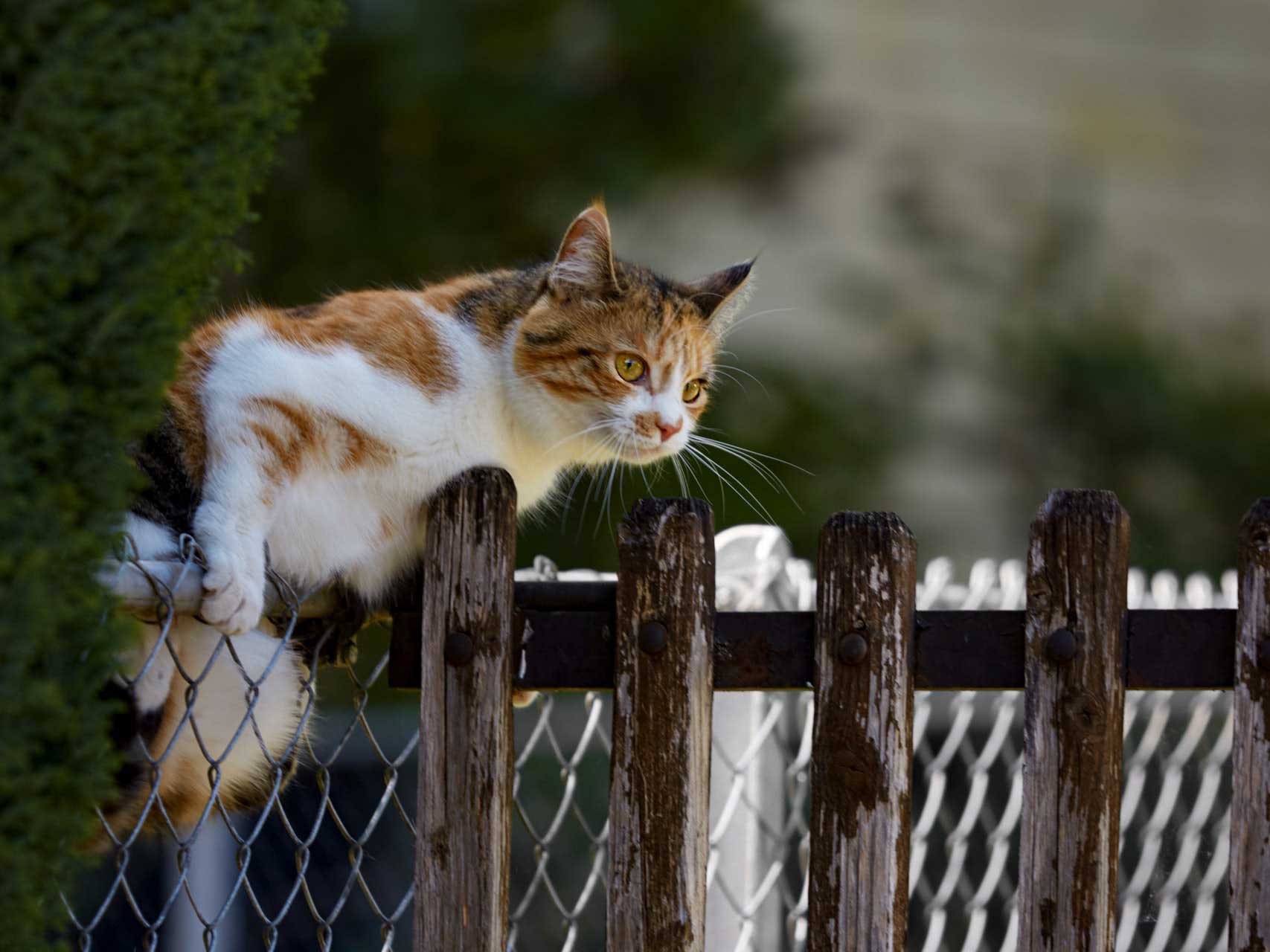
Have you ever wondered how your cat can do all the things it does? Have you found it on top of your fridge or high cabinets and wondered how and why? House (domestic) cats are felines related to leopards, bobcats, cougars, tigers, etc., and the cat family contains some of the most formidable predators on land. Unlike canines (wolves, coyotes, dogs, etc.) that hunt in packs, cats, with few exceptions, do it on their own. Pound for pound, cats are superior predators to canines, and that is due to their physical abilities, which, in turn, are due to their physical attributes. Cats can maneuver and conform their bodies much differently than dogs. Their limbs' ability to articulate makes them superior climbers, making it difficult to stop your cat from jumping over your fence. Other feline attributes, such as very flexible spines, strong muscles, and flexible joints, give them excellent balance and jumping abilities, as well as an impressive range of motion. Further to that, they have a peculiar trait known as righting reflex, which is a reflex that corrects the orientation of the body when it is taken out of its normal upright position. This trait allows them to take risks other animals would not attempt. It could even help your cat become a pro at jumping your fence. Cats always land on their feet, and now we know why – the righting reflex. Felis Catus It’s no wonder that it’s difficult to stop a cat from jumping over a fence. Your kitty, a domestic cat, known as Felis catus, evolved from the Near East wildcat, Felis silvestris lybica. The Near East wildcat, a subspecies of the African wildcat, is primarily nocturnal and solitary, and it hunts small game, including rodents, lizards, birds, and insects. Its hunting technique is to stalk and pounce. Although some live in areas with few trees, they are adept at climbing and do so to hunt and escape predators. A domestic cat’s physical attributes and capabilities do not vary much from those of its wild ancestors. The physical characteristics of their wild cousins are alive and well in the house cat (but you already know that if you can’t stop your cat from jumping over your fence). Jumping and Climbing The stalk and pounce is something everyone with a domestic cat is very familiar with (that’s super cute when playing), which is an obvious carryover from their wild origins. But the jumping and climbing attributes make containing domestic cats such a challenge, as most traditional fences can be scaled pretty easily by a cat jumping or climbing the fence. The only fence types that challenge most cats are vinyl privacy fences since a cat's claws do not sink into them for climbing. Also, tall estate-type fences with metal pickets spaced only two inches apart tend to deter some climbing. Securing an existing fence a cat cannot easily beat will always take adding something to the top (and not just any something) that the cat cannot climb around. The addition added to the top must also be high enough to stop your cat from jumping over the fence. Squeezing Into or Through the Smallest of Spaces Although cats will go right over easy-to-scale fences, going under or right through gaps is a natural second option. Cats can manipulate their bodies to fit under and into the tightest of spaces. Essentially, if there is enough clearance to fit their skulls, a cat will likely fit. A serious analysis of gaps or spaces within or under your fence and gates needs to be made. Although not the best diggers, they will work the ground under a fence to make a bit more room to squeeze out, so any space between the bottom of a fence and the ground needs to be analyzed. In addition to trying to stop your cat from jumping over a fence, you need to make sure the cat can’t squeeze or dig under gates and other breaks in the fence line where the fence ends at the house or where two different fences come together. More to Cat Proofing than Just the Fence In a perfect world, the only focus would be on the cat-proof fence and how to stop your cat from jumping the fence. However, there are many other considerations than just a cat-proof fence. Cat-proofing is a dynamic science. To do it thoroughly and properly, you must do your best to think like a cat. Consider the items in your yard that can be used for escape and systematically work to mitigate their use for escape. Doing so can help you stop your cat from jumping the fence. The configuration of your yard, the proximity of your home, garage, or buildings to the fence, and items near the fence, such as grills, AC units, benches, trees, or bushes, all create possible ways for a cat to escape. We could go on for days with all the things we have seen in the past 20 years. But below, we will review the most common things to look out for. Trees Trees are a very common issue that needs to be considered because cats can climb trees. Although much less common (at least inside fenced backyards), utility poles are also something cats can climb. If your feline can climb a tree that’s near the fence, it will be difficult to stop your cat from jumping the fence. Many trees and cat-proofing solutions depend on the tree type and proximity to the fence or building. Thinking like a cat looking to get out is key in determining if your trees are a possible route for escape. The question you are looking to answer is: if the cat climbs this tree, do you have to worry about the cat climbing or jumping onto the fence topper, a roof, or anything else that could then allow the cat to make its way towards an exit point that circumvents the cat-proof fence? Trees away from a building or the fence, with branches that do not reach near the fence or buildings, are usually not of much concern. This means that all other trees are likely worth looking closer at to ensure you can stop your cat from jumping the fence. For more information about working around trees, check out this article! Decks, Porches, and Steps Anything that can boost a cat up to jump to higher things (think roofs or the top of the fence topper) can lead to escape. Thinking like a cat is always key to evaluating your backyard structures. If a cat can get onto some existing structure in your backyard, where can it go from there? Cats can jump up to five feet (some a bit more) and climb things they can dig their claws into, hook their claws into, or paws around. As long as your cat can use a structure as a stepping stone, it may be difficult to stop your cat from jumping the fence. Any structure in your backyard needs to be thoroughly evaluated. Utilities (AC Units, Utility Meters, Utility Access Covers) These are things necessary to the functions/systems of your house that were placed where they were put with no thought to a future cat enclosure. AC units are big and obvious and can assist a cat in jumping a fence. If a cat can get itself past the fact that they blow air out the top and make noise (at least when operating), it can jump onto them and then jump onto other nearby things. Those things could be the top of the fence topper, a nearby shed roof, a low house roof, etc. Although low profile, small and inconspicuous to us, a utility box, gas meter, etc., mounted to your house are things a cat can easily jump on. If your cat can make its way onto one of these outdoor items, you may not be able to stop your cat from jumping the fence. Window Sills and Window Screens Cats can jump onto window sills. If the window sill is near something a cat can jump to, that will aid in its escape. Windows like this will usually need to be addressed. Cats can also climb screens. Screens on a window, even those without a space to jump from (window sill), may have a screen the cat can jump to and climb, thus aiding a cat in jumping a fence. If it can reach something else from that screen, especially the top of your fence topper, it could use it to escape. Another screen issue is when fences end against a screened-in room. This is not an ideal situation because cats can climb screens. If a screen room is the only place a fence can end, there may be options to stop your cat from jumping the fence, depending on the exact circumstances. Climbing the Exterior of Buildings Some buildings themselves are something a cat can climb. A determined cat can climb wood sidings, such as that from cedar and log homes. A very determined cat can climb very textured stucco and brick, especially light cats. Depending on your cat and the outside surface of the building, more may need to be done to where a topper system ends against a house or the building surface itself to make sure your cat does not use the building to make an escape attempt, such as jumping the fence, easier. Let Purrfect Fence Help! We are not suggesting you have to do any of these things or all of these things. The goal of this article is to help better inform you of the many preventable ways cats can escape a yard. We want to assist you with more than just fencing. We want to help you make sure YOUR cat or cats are safe by informing you how to stop your cat from jumping your fence. At Purrfect Fence, we offer much more than just the world’s most effective cat containment systems. If you are interested, we work with you individually to assess your enclosure space, identify potential problems, and holistically offer advice on how to best handle the challenge of keeping your cats from going over your fence. We take whatever time and effort are necessary to identify every possible problem and its solutions. Reach out to us by phone, email, or chat to start a conversation about creating a safe outdoor space for your cats that you can truly feel confident about!
Learn more
Cat-Proof Fence Options: DIY vs. Commercial
Cat-Proof fencing has become a popular concept in recent years. Ironically, it is often applied to things that are in no way “cat-proof” solutions. With a quick Google search on “how to cat-proof your backyard,” you will find multiple products claiming to offer cat-proof fencing as well as several DIY cat-proof fence tutorials on how to make your own from materials you can purchase from your local home improvement store. Regardless of the implementation, it ALL works SOMETIMES. The level of success you will have is directly related to the containment solution and the capabilities and motivations of the cats being contained. For example, we can safely say that a five-foot chain link fence would contain most humans over 70 years old and children seven years and younger. Yet there are certainly some of both age groups that could get over if they really wanted or needed to, but most would not be capable nor interested. A five-foot chain link fence would also contain humans of any age and ability who did not feel motivated to climb out. In the same way that a five-foot fence is successful at containing SOME people, many versions of cat-proof fencing will contain SOME cats. If you’re looking into how to cat-proof your backyard, let’s consider the ways you can create your very own DIY cat-proof fence. If you happen to have an existing fence made from wood, chain link, vinyl, block, metal, or brick, you may choose to modify it to make it cat-proof. If you do not have any fencing currently or choose not to use it for reasons such as it is in disrepair, it is a shared fence with a neighbor, or it is in close proximity to yard items that make it hard to cat-proof (such as AC units, bushes, grills, furniture, etc.), you might choose to build a new traditional fence then modify it with a DIY cat-proof fence system or build a brand new fence from specialty cat fence components. We will review each below. Modify an Existing Fence with a Cat-Proof Fence Topper When looking into how to cat-proof your backyard, remember that there are two general categories of cat-proof fences: ones added to the top of existing fences and ones built from the ground up. The option of outfitting a fence that already exists in your yard is the more crowded category, with many commercially available products as well as several “home remedy” DIY ideas presented online. Many DIY cat-proof fence ideas are essentially repurposing a shelf bracket or acting as a short horizontal extension to the top of a fence post. Some use small flag pole holders and dowels. Others, such as Purrfect Fence, use a patented and custom-engineered, spring-loaded arm purpose-built to offset the abilities and weight of a cat. A series of these are placed on fence posts of an existing fence, and chicken wire or plastic netting gets stretched between these brackets. As mentioned earlier, these can work for some cats. It is likely to work well for cats incapable or inclined to go the extra step of reaching out to the edge of that netting and pulling themselves up and over. Most shelf brackets are not intended for outdoor use and decompose relatively quickly, posing other problems. Some DIY cat-proof fence tutorials that show you how to cat-proof your backyard get more creative, like this one. These tutorials do not address possible problem areas, trees, gates, etc. In fact, the main picture (edited below) shows a raised planter right next to the fence a cat could easily use to jump over the cat topper. This is not to say it won't work for some cats. Actually, we find the work this Do-it-yourselfer did to be quite remarkable! Yet, in our 15 years of experience keeping 50,000+ cats safe outside, we know this setup will certainly fail to contain a significant portion of cats. If you have cats that already go out, are not super concerned about containing them, are somewhat handy, have a lot of time for experimentation (trial and error), and understand that you may end up redoing your efforts more than once to get it to work, a DIY cat-proof fence system may a good answer for you. If you’re wondering how to cat-proof your backyard without utilizing DIY methods, consider using commercially available fence topper systems for cat containment instead. Most of those are at least somewhat better than the DIY cat-proof fence options because they are more purpose-built for adapting to different fences and meant for outdoor exposure. These products also offer varying degrees of installation instructions. That said, this market runs the gambit on things such as strength, adaptability, and effectiveness. The companies that sell the products also offer varying degrees of product support, from providing none to putting together complete custom proposals, including trouble-shooting problem areas, so customers know what they need and how to apply it (as Purrfect Fence does). Learn More about Purrfect Fence Existing Fence Conversion System Modify an Existing Fence with a Cat-Proof Fence Roller Cat fence top rollers are repurposed “coyote rollers.” Coyote rollers are cylinders (like a length of pipe) that are 1.5-3 inches in diameter. They are placed just above the fence and spin. For comparison, think of running on a log in the water. An animal jumps up and tries to dig its claws into or clamber over the top of the fence. Instead of a solid top of the fence, it encounters something it cannot grip that spins. It loses its momentum and falls. DIY cat-proof fence roller online instructions do exist, but the ones using them are subject to the experimentation/trial and error process as well as the most basic of instructions. The commercially available rollers are less visible than standard cat fence topper systems. There are even a couple of commercially produced variations, including a type that is offset to the inside of the fence and one made with a bigger diameter having fins instead of a solid cylinder. Both are made to work better with cats. If you’re interested in how to cat-proof your backyard, keep in mind that all commercially available roller tops for cats are more expensive than traditional fence topper systems and the specialty ones are exceedingly so. DIY and commercial cat-proof fence coyote rollers work decently well for coyotes and other canines since they rely entirely on their upward momentum to clear the top of a fence. Cats, however, have different capabilities. A cat can climb up a fence and stop, hanging there by its claws. A motivated cat can learn to reach over the spinning bar or even use it to roll itself over. Its success is determined by the abilities and determination level of the cats being contained. As one of the more costly options, roller bars may not be a financially wise solution for some people. We work with customers often that have previously installed these types of deterrents only to find they did not work well for their cats. Creating a Cat-Proof Fence from the Ground Up This is what you are looking at if you do not have a fence at all or your existing fence is not appropriate to be cat-proof for one reason or another. There are a lot fewer DIY cat-proof fence options for this. All cat containment methods rely on the cat not being able to jump right over it. The “cat-proofing” part must be high enough that the cat cannot clear it with a jump. This requires a vertical component. So cat-proof fences from the ground up require a fence system with a cat-proofing method added to or incorporated into the top. When looking into how to cat-proof your backyard, remember that a lot of inexpensive DIY cat-proof fence options do not offer the needed height or stability to add something to the top that will be stable over time. If they do, they really are just traditional fences that someone put up themselves instead of hiring a contractor, in which case you are back to cat-proofing an existing fence (see above). There are a handful of companies that offer “cat-proof” ground-up fencing kits. These are mostly novel traditional fence bottoms with a cat-proofing component at the top. The novel part is that they were mainly designed around ease of installation by a handy homeowner, making the cat-proof fence an easy DIY project. In many ways, the vertical/traditional fence portions of these different offerings are relatively similar. The distinctions come primarily with the cat-proofing top. That is not to say they are all the same except for the top. Some have put more thought and better materials into the lower portion of the fences. That said, the tops are the true differentiator when only considering containing cats. Learn More about Purrfect Fence Freestanding Cat Fence System What to Consider When Deciding How to Cat-Proof Your Backyard This is a complex question that must take several factors into consideration. Factors include your setting, the capabilities of the cats to be contained, your budget, and risk tolerance. If your budget is low and your risk tolerance (the ability to tolerate failure) is high, and you have the time for trial and error, then a DIY cat-proof fence option, including hardware and store supplies, may be your best option. If your budget is low and risk tolerance is high, but you do not have a lot of time, then one of the more basic commercially available cat topper systems may be right for you. If you do not have a fence to cat-proof, you have additional factors to consider, such as do you want to put up a traditional fence (DIY or contractor installed) or use a commercially available ground-up cat-proof fence system? If you decide to go the route of purchasing a commercially available cat-proof fence product/system (topper only or ground up) instead of a DIY cat-proof fence, you will need to consider your needs and expectations in making that choice. If your fence topper needs are simple (let us say a six-foot tall wood privacy fence with no trees, sheds, etc. near the fence), your risk tolerance for failure is high, and/or your cats are not very capable or motivated, then the most basic topper system may be your best option when deciding how to cat-proof your backyard. Along those same lines, if you need a ground-up fence and have a very simple layout (rectangle) with no trees and your risk tolerance for failure is high and/or your cats are not very capable or motivated, one of the more basic ground-up commercially available systems may be right for you rather than a DIY cat-proof fence. If your needs are complex and/or your cats are capable and/or motivated, and you want a proven system that works in the widest array of scenarios on even the most talented escaping kitties, you really only have one choice (shameless plug shrouded in honesty). Let Purrfect Fence Help You Choose the Perfect Containment System for Your Cat Purrfect Fence has been the leading innovator and #1 preferred provider of systems for outdoor cat containment since 2004. We hold several patents for our innovations and are regarded in the US, Canada, the UK, Europe, Australia, France, Belgium, Switzerland, and South Africa for building the world's most effective and durable cat containment solutions. Not only do we have the most advanced and effective systems, but we also work with our customers at a level that no one else does to determine the best DIY cat-proof fence solution for their situations. We consult with you (and your installer, if hiring one), ask for pictures and diagrams, and consider all factors available prior to giving our recommendations. In the process, we spell out any special work, etc., that falls outside our well-written and detailed instructions. Sometimes that means we say they do not have a viable option for cat-proofing. We may spend hours with a potential customer to reach that conclusion. But in the end, the safety of your cats, comfort, and collective enjoyment are the most important aspects of the cat-proofing process. If you’re trying to figure out how to cat-proof your backyard, please call, email, or chat with us online to find out why we’re the leader in keeping cats safe and happy outdoors! Our planning engineers will be happy to assist you in creating the enclosure of your cat’s dreams!
Learn more
Outdoor Access is Key to Your Cat's Mental & Physical Health
by Kelley Bollen, MS, Certified Animal Behavior Consultant (CABC) We all know how nice it is to get outside on a beautiful sunny day. There’s just nothing better than taking a nice walk in the park - breathing in the fresh air, feeling the sunshine on your face, smelling the scent of the pine trees and watching the squirrels play and scurry among the leaf litter. Well, your pet cat has the same desire to experience the wonders of the outdoors as you do. Unfortunately, many cat owners don’t give their cats the opportunity to spend time outside for fear that they will get hit by a car, be killed by a neighborhood dog or get lost and never return. While I certainly understand the dangers of the outdoor world for cats, allowing outdoor time is one of the most enriching things you can do for your cat and there are ways that you can do it safely. Cats are stimulated by all of the sounds, sights, and smells of nature As an animal behaviorist, I understand the needs of animals. I have been consulting with pet owners for almost twenty years and I can tell you that many of the behavioral issues that I am called in to help with are exacerbated by a lack of mental and physical stimulation. Every single behavior plan that I create for my clients, regardless of the presenting behavioral issue or the species of animal, involves stimulating the pet’s brain through opportunities to experience the outdoor world. Cats have a finely tuned sense of smell, vision, and hearing. All of which tend not to be properly stimulated indoors The wonders of the outdoor world are many. Cats who are given the opportunity to spend time outside are stimulated by all of the sights, sounds, and smells of nature. This exposure provides much needed mental stimulation that indoor-only cats miss out on. Knowing this, it’s obvious how stimulating the smells of the outdoor world are for cats. Sense of Smell Let’s start by considering a cat’s olfactory sense. While most people know that dogs have an amazing sense of smell, very few people understand how important this system is for cats. Olfaction is a cat’s most powerful and important sense. A cat gathers a lot of information about their environment through their sense of smell. Additionally, they use this system to find prey and even to identify social partners. Sense of Hearing A cat’s auditory sense is also quite amazing. Cats can even hear sound in the ultrasonic range that humans have no perception of. Some sounds, like bird songs, are extra interesting to cats. The sounds that birds make are ‘biologically significant’ to cats. This means that they pique a cat’s interest automatically - instinctually. Sense of Vision Lastly, when we consider a cat’s visual sense, imagine all of the interesting things they can watch when outside. Cats cannot only see in the dark but they have motion-sensitive vision so the tiniest of motions can stimulate a cat’s interest. Many behavioral issues have been linked to a lack of outdoor activity I have many cat-owning clients who can attest to the benefit of their cat having safe outdoor access. One particular case that comes to mind was a cat who had sprayed in the house so often that the owners needed to replace not only the carpeting but also the subflooring under it. Once we were able to give their cat outdoor access he stopped spraying in the house. Outdoor access is a primary way to relieve stress and enrich a cat’s life I also work with animal shelters across the country. My work in this field involves teaching the shelter staff how to reduce the stress of captivity and how to provide enrichment (mental and physical stimulation) to keep the cats behaviorally healthy during their shelter stay. Access to the outside environment goes a long way to accomplish both of these things. Allowing cats to have free time outside not only reduces the stress of living in a small cage but the outdoor environment provides considerably more enrichment for the cats than anything that could be given to them inside their cage. Simply stated, the benefits to cats of having the opportunity to spend time outdoors cannot be overstated. The outdoor environment is full of things that stimulate their interest and all of their senses. And nothing is better than taking a nice catnap in the warmth of the sunshine while breathing in the fresh air. The methods for which to provide safe outdoor space are many. Whether you choose specialty cat fencing, an outdoor cat enclosure, or just a small portable tent-like enclosure. The more space the better but any kind of outdoor space however small or infrequent is better than none at all. About The Author Kelley Bollen, MS, CABC Certified Animal Behavior Consultant Kelley is a nationally recognized and respected Animal Behaviorist who holds a Master’s Degree in Animal Behavior. She is a Certified Animal Behavior Consultant (CABC) and has worked with Cornell University College of Veterinary Medicine, Cummings School of Veterinary Medicine at Tufts, Humane Network, Massachusetts Society for the Prevention of Cruelty to Animals, and many more. Kelley has also worked with and consulted with countless rescue / shelter organizations and individual pet owners. Kelley resides in beautiful Reno, Nevada with her six cats and two mini goats. Kelley Bollen: Website Facebook Disclaimer: Kelly Bollen is a customer of Purrfect Fence. The unbiased information expressed in this article is based on her decades of expertise in animal behavior and is consistent with the consulting and training she provides to shelters, rescues, and individual pet owners allover the world.
Learn more